A simple lock-free queue in C++
A while ago I needed a simple lock-free queue in C++ that supports a single producer as well as one consumer. The reason to use a lock-free data structure instead of a regular std::queue guarded by mutex and condition variable for me was to avoid the overhead of exactly those mechanisms. Also since I never came in contact with the interesting concept of lock-free data types, I thought this was an excellent opportunity to look into the matter.

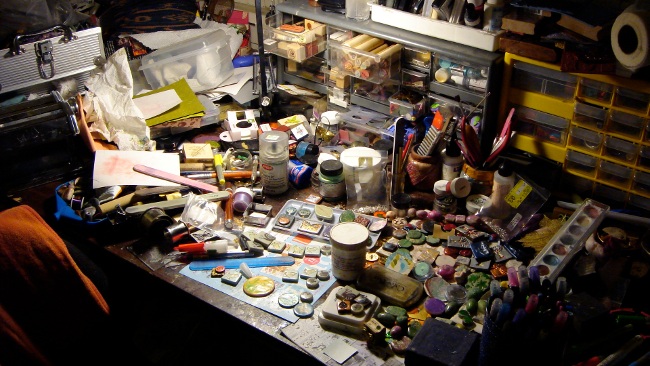
You can never go too far, image by Baboon
Unfortunately (or fortunately) I could not find a production ready lock-free queue in C++ for my platform (Linux). There is the concurrent_queue class available in Visual Studio 2010, there’s the unofficial Boost.Lockfree library (code is here) but those options were not satisfying. I needed something simple that worked right out of the box.
Herb Sutter wrote an excellent article a while back about designing a lock-free queue. It’s straight forward and functional. The only flaw it has from my point of view is the use of C++0x atomics which I wanted to refrain from including in my project for now. There’s of course the unofficial Boost.Atomic library, but again I wanted something simple.
So I reread Herbs article, especially the passage that explains the requirements for a “lock-free-safe” variable: atomicity, order and the availability of a compare and swap operation. Digging into the Boost.Atomic code I found that it is rather simple to get atomicity and order when using gcc. I’m using version 4.4.3.
Atomicity can be ensured using the atomic functions of gcc and order can be ensured using a memory barrier trick:
type __sync_lock_test_and_set (type *ptr, type value)
asm volatile("" ::: "memory")
The first line is an atomic test and set operation and the second line is equivalent to a full memory barrier. With this functionality I was all set. Here is the modified code for the method the producer calls:
void produce(const T& t)
{
last->next = new Node(t); // add the new item
asm volatile("" ::: "memory"); // memory barrier
(void)__sync_lock_test_and_set(&last, last->next);
while(first != divider) // trim unused nodes
{
Node* tmp = first;
first = first->next;
delete tmp;
}
}
I replaced the atomic members with regular pointers but exchanged the assignments that require atomicity and order by calls to __sync_lock_test_and_set preceded by the full memory barrier trick. The function call must be cast to void to prevent a “value computed is not used” warning.
bool consume(T& result)
{
if(divider != last) // if queue is nonempty
{
result = divider->next->value; // C: copy it back
asm volatile("" ::: "memory"); // memory barrier
(void)__sync_lock_test_and_set(÷r, divider->next);
return true; // report success
}
return false; // else report empty
}
The full class can be downloaded here. Please note that the class lacks some important functionality if your use-case is non-trivial (a proper copy-constructor comes to mind).
What it is all about
There is a collection of definitions of lock-free and non-blocking and wait-free algorithms and data structures that can be interesting to read.
The idea of lock-free data structures is that they are written in a way that allows simultaneous access by multiple threads without the use of critical sections. They must be defined in a way that at any point in time any thread that has access to the data sees a well defined state of the structure. A modification was either done or not done, there is no in-between, no inconsistency.
This is why all critical modifications to the structure are implemented as atomic operations. It also explains why order is important: before critical stuff can be done, preparations have to be finished and must be seen by all participants.
On Supercomputers
Supercomputers are an integral part in today’s research world as they are able to solve highly calculation-intensive problems. Supercomputers are used for climate research, molecular modeling and physical simulations. They are important because of their capacity as they provide immense but cost-effective computing power to researchers. It’s power can be split across users and tasks, allowing many researchers simultaneous access for their various applications. Supercomputers are also essential because of their capability. Some applications might require the maximum computing power to solve a problem – running the same application on a less capable system might not be feasible.

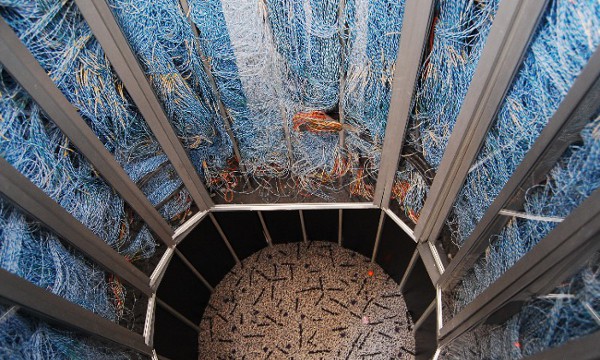
Cray 1 Core, image by carrierdetect
Supercomputers themselves are an interesting research topic and excite scientists of many branches of computer science. I myself have been working in the area of tool development for high performance computing, an area closely related to supercomputers. I therefore follow the current development in this area and even dare to speculate about what is going to happen next.
Recent Development
We have seen how the gaming industry and high performance computing stakeholders started working together to develop the Cell microprocessor architecture that is being used both for game consoles and supercomputers. Recently, a similar collaboration caused an outcry in the global supercomputing community when China finished their Tianhe-1A system that achieved a peak computing rate of 2.507 petaFLOPS making it the fastest computer in the world. It is a heterogeneous system that utilizes Intel XEON processors, Nvidia Tesla general purpose GPUs and NUDT FT1000 heterogeneous processors (I could not find any information about the latter).
While these computers are impressive, they are built in what I would call the conventional way. These systems are really at the limit of what is feasible in terms of density, cooling and most importantly energy requirements. Indeed, the biggest challenge for even faster systems is energy.
Upcoming Systems
Right now the Chinese system got the upper hand but IBM is building a new system in Germany called the SuperMUC (German). While using commodity processors, this new system will be cooled with water – a concept I suspect we will see a lot in the future. It is expected to drastically reduce energy consumption.
Another computer that is probably going to dwarf everything we have seen so far is Sequoia system by IBM. Utilizing water cooling like the German system, it is a Blue Gene/Q design with custom 17-core 64bit power architecture chips. The supercomputer will feature an immense density with 16,384 cores and 16 TB RAM per rack. As this system is aimed to reach 20 petaFLOPS it is a great step toward the exascale computing goal. Personally I would love to get my hands on a rough schematic of the Blue Gene/Q chip as it somewhat reminds me of the Cell processor: it also has 1 core to run the Linux kernel and a number of other cores for computation. What I would like to know is if the cores share memory or if they have dedicated user programmable caches that are connected via a bus.
The role of ARM
I’ve been wondering for a while now if ARM will try to get a foot into the HPC-market. ARM Holdings is a semiconductor (and software) company that licenses its technology as intellectual property (IP), rather than manufacturing its own CPUs. There are a few dozen companies making processors based on ARM’s designs including Intel, Texas Instruments, Freescale and Renesas. In 2007 almost 3 billion chips based on ARM designs were manufactured.
While ARM is considered to be market dominant in the field of mobile phone chips, they just recently started to break into other markets, especially servers and cloud-computing – also including high performance computing. Their new Cortex-A15 processor features up to 4 cores, SIMD extensions and a clock frequency of up to 2.5GHz while being very power-efficient. We will have to see how this plays out but I can imagine that for example the Exascale Initiative is very interested in something like this.
Your own embedded supercomputer (sort of)
A processor similar to the new Cortex-A15 is the OMAP 4 CPU by Texas Instruments. It is a Cortex-A9 dual core processor with SIMD extensions. While targeted at mobile platforms, this CPU is very similar to the upcoming high performance chip since it supports the same instruction set. There exists a cheap, open source development board for aforementioned Coretex-A9 called the Pandaboard. It sells for less than $200 and is a complete system that runs Ubuntu. In my opinion, this can be seen as single node of a high-performance but power efficient computer cluster.
Open Kinect Prize
As stated in my 3D Vision for Embedded Systems post, Microsoft’s Kinect could be an extremely useful tool to give robots 3D vision. Now the fine people from Adafruit offer a prize for it. If you can provide open source software that gives access to the Kinect video signal (RGB) and distance values they will pay you 1000$. A tempting offer. I’m looking forward to seeing the results.
Update: The guys from ifixit.com got their hands on a Kinect and took it apart. The article shows detailed images of everything and even identifies all integrated circuit chips found inside the device.
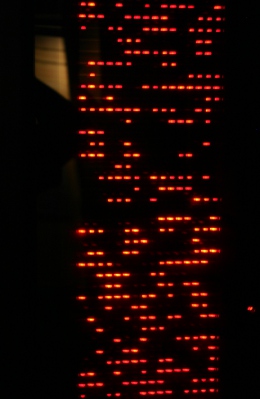
Second update: Adafruit increased their offer to now $3000 and it looks like the problem isalready solved, at least partially. Check out this youtube video of the Kinect displaying RGB-D information on Windows 7. The depth information looks somewhat weird though. New updates can be found here. This video shows what the infrared projection of Kinect looks like. Pretty cool!
Third update: It is done! There now exists an open source driver for Microsoft’s Kinect. Adafruit announced the winner of the $3000. And more importantly the code can be found here.
Diffie-Hellman key exchange in Javascript
The Diffie-Hellman key exchange protocol (RFC2641) is an efficient way for two parties (that do not know each other beforehand) to establish a shared secret. This secret can then be used for encrypted communication between the two parties. Because of the simplicity of the algorithm it is a feasible to implement it in Javascript. It could serve as a way to communicate between to participants of a social network in a host-proof way (meaning the host can not access the messages that are exchanged between Alice and Bob).
The following straight forward implementation is based on the ingenious BigInt Javascript library created by Leemon Baird:
function d_h()
{
// Alice tries to send to Bob, they agree on a 256 bit prime
var p = str2bigInt(
"10883804965994030335610375728683210724614077" +
"5791152305372594007835539736018383", 10, 80);
var g = str2bigInt("2", 10, 80); // and on a generator
// Alice chooses her secret randomly
var a = str2bigInt(
"3103830701216420526524336327874353922197141754" +
"5159778383387464250", 10, 80);
// Bob chooses his secret randomly
var b = str2bigInt(
"26264611999731746945409581849451656136966431" +
"516270225144913718599547", 10, 80);
// calculate the public key
var A = powMod(g,a,p); var B = powMod(g,b,p);
// A and B are exchanged publicly
// Alice and Bob can compute the same key from A and B
var a_sec = powMod(B, a, p);
var b_sec = powMod(A, b, p);
alert(bigInt2str(a_sec, 10) + '\n ' + bigInt2str(b_sec, 10));
}
Update: Please note that the following code might produce an insecure generator. An alert reader pointed out that the values it returns for g are too small.
In case you wonder how to choose p and g – so did I. Turns out a generator for those numbers is part of the Crypto++ library. The following application uses this library to calculate p and g with different length.
#include <iostream>
#include <vector>
#include <tclap/CmdLine.h>
#include "dh.h"
#include "osrng.h"
using namespace std;
using namespace CryptoPP;
using namespace TCLAP;
int main(int argc, char** argv)
{
// read command line
CmdLine cmd("Diffie Hellman p g generator", ' ', "0.1");
UnlabeledMultiArg<unsigned int> m("bv", "bits and values", true, "");
cmd.add( m ); cmd.parse(argc, argv);
vector<unsigned int> mv = m.getValue(); mv.push_back(1);
unsigned int bv = mv[0]; unsigned int nv = mv[1];
AutoSeededRandomPool arngA; // generate p and g
RandomNumberGenerator& rngA =
*dynamic_cast<RandomNumberGenerator *>(&arngA);
for(unsigned short i=0; i<nv; i++)
{
DH dhA(rngA, bv);
cout << "p=" << dhA.GetGroupParameters().GetModulus() << " g=";
cout << dhA.GetGroupParameters().GetSubgroupGenerator() << "\n";
}
return 0;
}
The application uses the TCLAP library to parse the command line. The first parameter should be the width of the prime number in bits, the second optional parameter specifies how many primes and generators should be calculated.
Here’s a list of p and g I generated with different widths:
128 bits: p=197221152031991558322935568090317202983 g=2 256 bits: p=11245712998331706449413325803449175679094351102802336690101496856041 0379195027 g=3 512 bits: p=85591083890203292422929753448312002013227700164244056883767436387780 3988137714894694780639823858404151944019992782250585325661689168497741 6276395927762259 g=3 1024 bits: p=10756096062425499020105845514001321706994933124811434157429824859705 5584898126321093330768462486995125563469663163251404817709163750190539 8111908385982976186475492023836046174671146008757104643109463540714363 4989690852152224155785251701387082100575086970999263664414942032660939 2283245879753842682719140993487 g=2 2048 bits: p=28401819833194672263220074318568239913240629340614134316461681527129 7400190276361407578313119949940155208450277590596255133024483132860231 2683364685437571458516690608818388566379408009734093619889676676688482 4330230759478149039933887325452487112982841213248410034360015394086822 8492443771741195501623918057531604439427869721645027989688343068984123 6647850119363273567137904693671110310979494733094653291727319950103948 4827099108375018229688415849095088940888827138097109161920916553046346 9800257941704054817481593649080741474714321422084101095199976587101477 59474207550469840261684005212634493995003979085986141372247 g=2
Those numbers do not have to be calculated every time but in fact can be hard-coded in your application.
3D Vision for Embedded Systems
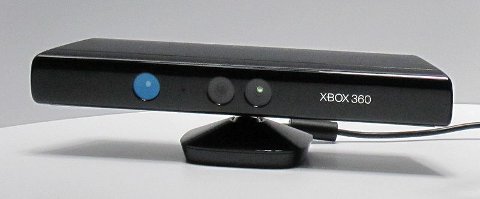
3D Vision is an integral part of every autonomous robot. Getting it right is not trivial and certainly not cheap. We struggled with this problem ourselves when trying to build an autonomous Mikrokopter drone. Cheap systems are not very reliable, good systems are disproportionately expensive and often very heavy. However I believe there may be hope yet for usable and cheap 3D vision systems for hobbyist and hackers alike. Granted, Microsoft is a rather unexpected reason for such hope but their Project Natal (now Kinect) might just be what we have been waiting for (image by litheon).

It’s a structured-light 3D scanner developed by PrimeSense. While being used for measuring the three-dimensional shape of an object I think it should be possible to use it as a 3D vision system for indoor robots. So I would really like to see hackers taking this cheap device apart and re-purposing it for home-brew 3D vision. In their paper “A low cost 3D scanner based on structured light“, Rocchini et al. describe how to build one and this incredible instructables article explains how to build one also and even provides source code.
Of course there are other exiting technologies out there, a comprehensive list of 3D vision devices can be found at acroname.com (including prices). The devices range from expensive but effective and impressive Time-of-flight cameras (vendors: [1] [2] [3]) to LIDAR systems. The latter were very successfully used in DARPA’s Urban Challenge autonomous driving competition. A very interesting video that describes how LIDAR works in detail is available at blip.tv.
Of course there’s also the good old ultrasonic and infrared sensors that are cheap and have low resolution and are moderately reliable but they can certainly be very useful.
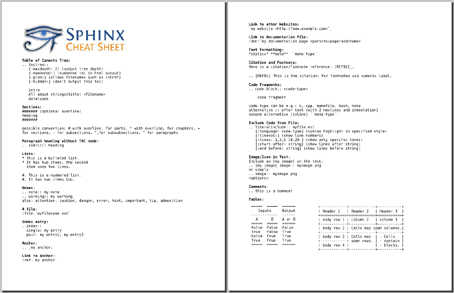
Sphinx Cheatsheet
I find myself working with the Sphinx Documentation Generator a lot recently. It is a great tool to easily create intelligent and beautiful documentation and it is based on reStructuredText. I put together a cheat sheet of all the commands I frequently use. There are a number of very good ones out there ([1] [2] [3] [4]) but I find it more convenient to work with my own.
You can access the PDF from here and the source (OpenOffice Writer document) here. If you find it useful or would like an item added, feel free to leave a comment.
Matlab C++ Integration
I’m currently working on integrating some Matlab Algorithms into a larger C++ project using the Matlab Compiler. It works rather well however I stumbled across a couple of quirks and caveats. First two facts that make integrating Matlab difficult: in Matlab indexes start at 1 and Matlab arrays are column-major ordered. As a result if you want to use data fields in both C/C++ and Matlab you have to transpose the fields. If the fields contain indexes you might also have to increment and decrement the values of the fields.
Another caveat I found is also related to array indexes. When using a Matlab function that takes as parameters matrix indexes you might think of creating an mwArray of type mxUINT32_CLASS. Wrong. You have to pass indices – as strange as it sounds – as doubles so you should use mxDOUBLE_CLASS.
One custom Matlab function I wanted to use in C++ took as an argument a cell array. A cell array is an array containing other arrays. In Matlab you create a cell array like this:
a = magic(5);
b = ones(3);
z{1} = a;
z{2} = b;
If you look at z now you will get something like this:
z =
[5x5 double] [3x3 double]
An array of arrays. Easy. Well if you want to construct a cell array in C++ you have to do something like this:
mwArray a(5, 5, mxDOUBLE_CLASS);
mwArray b(3, 3, mxINT16_CLASS);
mwArray z(1, 2, mxCELL_CLASS);
z.Get(1,1).Set(a); // Sets z(1) = a
z.Get(1,2).Set(b); // Sets z(2) = b
You can find the description on this page.
If you get used to those little quirks however the Matlab Compiler is a very powerful tool to include your crazy Matlab scripts in a stand alone C++ application. One of the next things I would like to investigate are free (open source) Matlab Compiler alternatives such as the Octave C++ integration and compiler.
Civilian autonomous and remote controlled drones
Here’s a quick summary of some of the most interesting autonomous and remote controlled drones out there today. The occasion is that I and 3 others have built a quadcopter drone last semester with the goal to fly it autonomously. While the time we had to finish the project was limited and our project did not reach full autonomous flight just yet we learned a lot about the system and the challenges of such an endeavor. One team member has made the project his diploma thesis and continues to work on the vehicle.
The two images show our drone dubbed B.I.R.D. (Basic intelligent research drone) in flight and the microcontrollers and sensors that control the drone. It is based on the the Mikrokopter project.
Another very interesting drone is the nano air vehicle by AeroVironment. It’s a flapping-wing vehicle for indoors use. Check out this amazing video to see it in action. I’m guessing that while the flapping-wing design is a lot more complicated than the brushless motors in our drone it is more energy efficient.
The third drone I would like to share was built by Armadillo Aerospace. They claim level 2 of the Northrop Grumman Lunar Lander Challenge with it. For more information read on here and be sure to check out this video. Notice how large this vehicle is (can be seen in the end of the video).
The fourth drone is really scary. And it’s not civilian at all. It’s called the Multiple Kill Vehicle and was supposed to shoot down intercontinental rockets in space. The project is apparently canceled but the video is impressive and scary nevertheless. Check it out here.
Update: Researchers at MIT’s Robust Robotics Group have developed a robotic helicopter capable of autonomously flying inside buildings or other GPS-denied environments. Here’s a very interesting video about their project. They achieved what we planned for our project – and I have to say it is very impressive and they did an excellent job.
Visualizing Multithreading
I’ve been pondering about the question of how to model and visualize multithreaded applications in a simple, efficient and aesthetic way. Naturally I’ve been looking into UML behavior diagrams first but I was not really satisfied with what I found. Now I am not an expert on UML but I know my way around class diagrams, activity diagrams, sequence diagram and state machines but they all did not seem to fit what I wanted to visualize.
I wanted to show multiple threads communicating and synchronizing with each other. I’ve read the argument that something like multithreading concerns only the implementation of a system and can thus be ignored when modeling. I agree with the argument however there will come a time in the development phase of a system when one needs to think about multithreading and one wants to sketch out how the system facilitates multiple threads to be efficient. And for that I have not found good tool within UML.
So I searched for examples of diagrams that visualize multithreading. The collage shows 4 different diagrams I found rather interesting. The first one is from this page about a traffic simulator written in Java (orignal image). It shows different threads and how they signal each other. It’s simple yet quite clear what is going an. The second image is taken from a CodeProject documentation about a genetic library (original image). It sort of uses UML symbols but it’s not clear what happens at the fork and join points. The way I figure it, those symbols inside the threads are supposed to be branches not forks. The third image is also from a CodeProject page – this time it’s a how-to about avoiding an exception when using multiple threads (original image). It reminds me of a sequence diagram. There are no blocking states in the diagram and I figure in this particular application the threads are non-blocking so diagram fits the application perfectly. The fourth diagram I liked the most. It’s from the Multithreaded Programming with ThreadMentor tutorial (original image) and has special symbols for sending signals and waiting for signals.
So I gave it a try myself and tried to model a simple controller and worker thread scenario based on the last of the example diagrams I found. The gray boxes and circle represent a signaling concept where one thread can send a signal and the other thread waits until it receives the signal. I also included a shared variable that handles the task shutdown. One thread can set the variable and the other branches depending on that variable. I am not happy yet with this particular part of the image. If anyone has a better idea or pointer to resources on that topic feel free to leave a comment.
My 25 favorite Windows Applications
Here’s a list of my 25 favorite windows applications. They are all open source or free to use. By the way with most Linux distributions you get the functionality those tools provide right out of the box.

7-Zip is an open source file archiver with a high compression ratio. It supports all common archive types. Avast is a free (for personal use) anti virus kit, that protects my system from all those nasty pieces of software out there. Cygwin is an ingenious collection of tools that provides a Linux-like environment for Windows. You can use it with puttycyg to get a very easy to use Linux-like shell with all the tools you miss so badly on Windows. And for those good old DOS games you miss so much there’s DOSBox, the x86 emulator with DOS. Check out a number of old free but totally awesome games you can play on the DOSBox here. For file-transfers there’s FileZilla for FTP and for SFTP there’s WinSCP. And of course there’s everybody’s favorite browsers Firefox and Opera for browsing and ‘being connected’. From what I hear Opera 10 will be out any day now. For my document viewing, editing and creation needs I heavily rely on Texmaker, MiKTeX, GSview and of course OpenOffice.org.
For image creation I just love Inkscape. It has to be one of the greatest open source tools ever created. For graph creation I use gnuplot also I have to say I have been using the graphing tools of MATLAB a lot lately due to ease of use. For text and code editing I use either Notepad++ or Vim. It depends on my mood really. To communicate online I use mostly the cute pidgin universal chat client but I also sometimes log on to IRC using mIRC. For all my media and entertainment needs I have the great and famous VLC media player of course but I tend to use Winamp for audio playback. To download torrent files I use µTorrent and to connect to remote servers I use PuTTY.
I use XAMPP for web development and the ingenious VirtualBox x86 virtualization software for testing on different systems. When my harddrives are a cluttered mess I use WinDirStat to get a hold of the chaos and clean it up. And recently I accidentally deleted files from the SD-Card of my mobile phone and was able to recover them instantly using the awesome Photorec data recovery software.
That’s it for my list. I hope someone out there will find this list useful.
« Newer Posts — Older Posts »